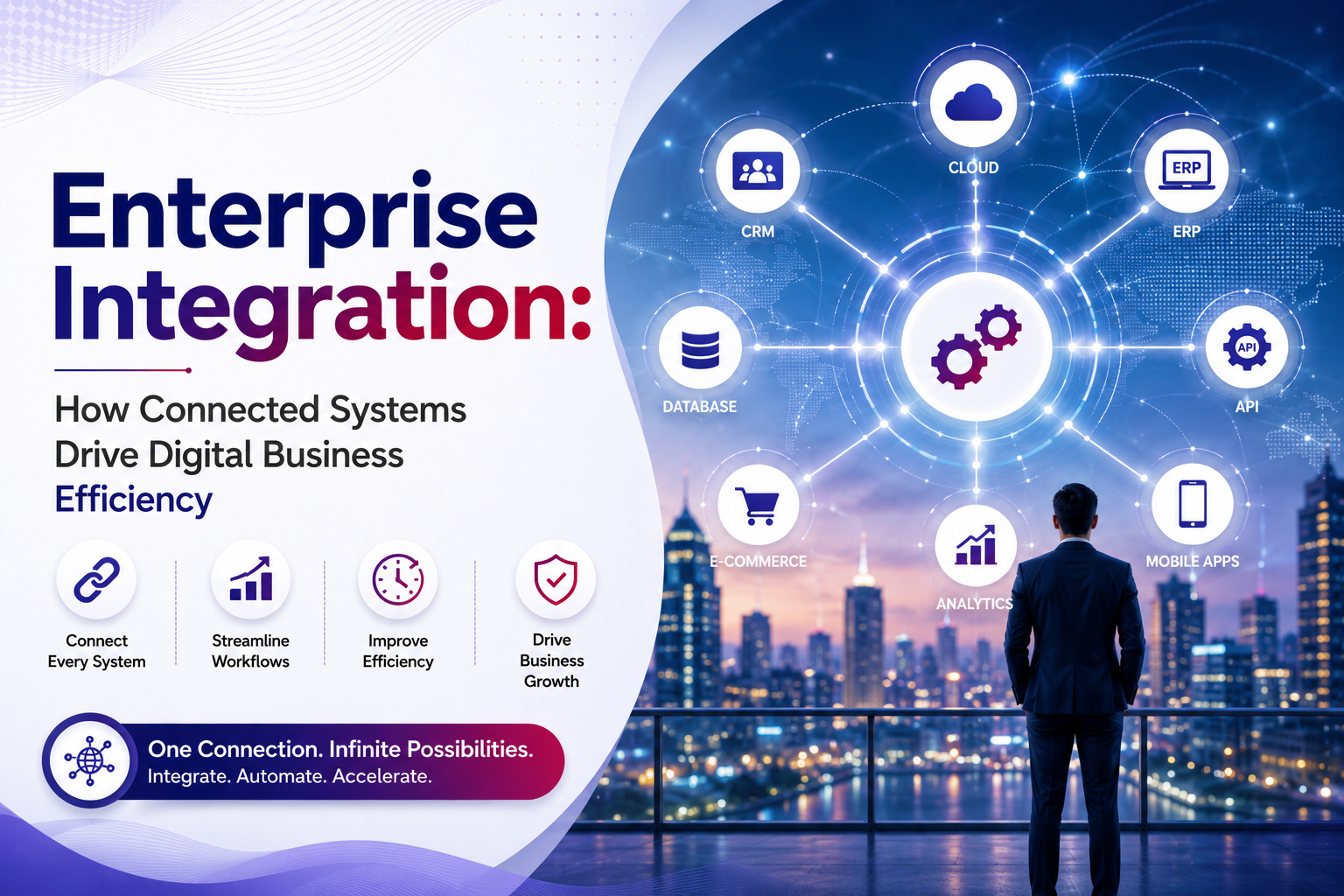
Enterprise Integration: How Connected Systems Drive Digital Business Efficiency
- By Admin
- 15 Jul , 2026
- Integrations
Enterprise Integration: How Connected Systems Drive Digital Business Efficiency
Modern businesses rarely operate with a single application. CRM platforms, ERP systems, cloud applications, databases, APIs, communication tools, and analytics platforms all play important roles.
The challenge is making these systems work together.
Enterprise integration enables applications and platforms to exchange information and work together as part of a connected technology ecosystem.
1. Why Enterprise Integration Matters
Disconnected systems often create:
-
Duplicate data
-
Manual data entry
-
Delayed information
-
Operational inefficiencies
-
Reporting inconsistencies
-
Poor customer experiences
Integration helps organizations establish reliable information flows between systems.
2. Common Integration Approaches
API-Based Integration
APIs enable applications to communicate securely and exchange data programmatically.
Enterprise Application Integration
EAI connects different enterprise applications and allows information to move across business systems.
Event-Driven Integration
Event-driven architectures allow applications to respond to real-time business events.
Cloud Integration
Cloud integration connects SaaS applications, cloud platforms, and on-premises systems.
3. Popular Integration Use Cases
Organizations commonly integrate:
-
CRM and ERP systems
-
Marketing and sales platforms
-
Customer service applications
-
Payment systems
-
Data warehouses
-
Cloud applications
-
Internal business applications
4. Benefits of a Connected Enterprise
A well-designed integration strategy can provide:
-
Real-time data exchange
-
Reduced manual processes
-
Better data consistency
-
Improved workflow automation
-
Greater operational visibility
-
Faster business decision-making
5. Best Practices
Successful integration requires more than connecting two applications.
Businesses should:
-
Define integration objectives.
-
Establish data ownership.
-
Design scalable APIs and interfaces.
-
Apply security and access controls.
-
Monitor integration performance.
-
Plan for error handling and recovery.
-
Document integrations properly.
Conclusion
Enterprise integration is becoming a fundamental part of modern digital infrastructure. When applications and data work together seamlessly, businesses can reduce complexity, automate processes, and respond faster to changing customer and market requirements.
A strong integration strategy creates the foundation for a truly connected enterprise.