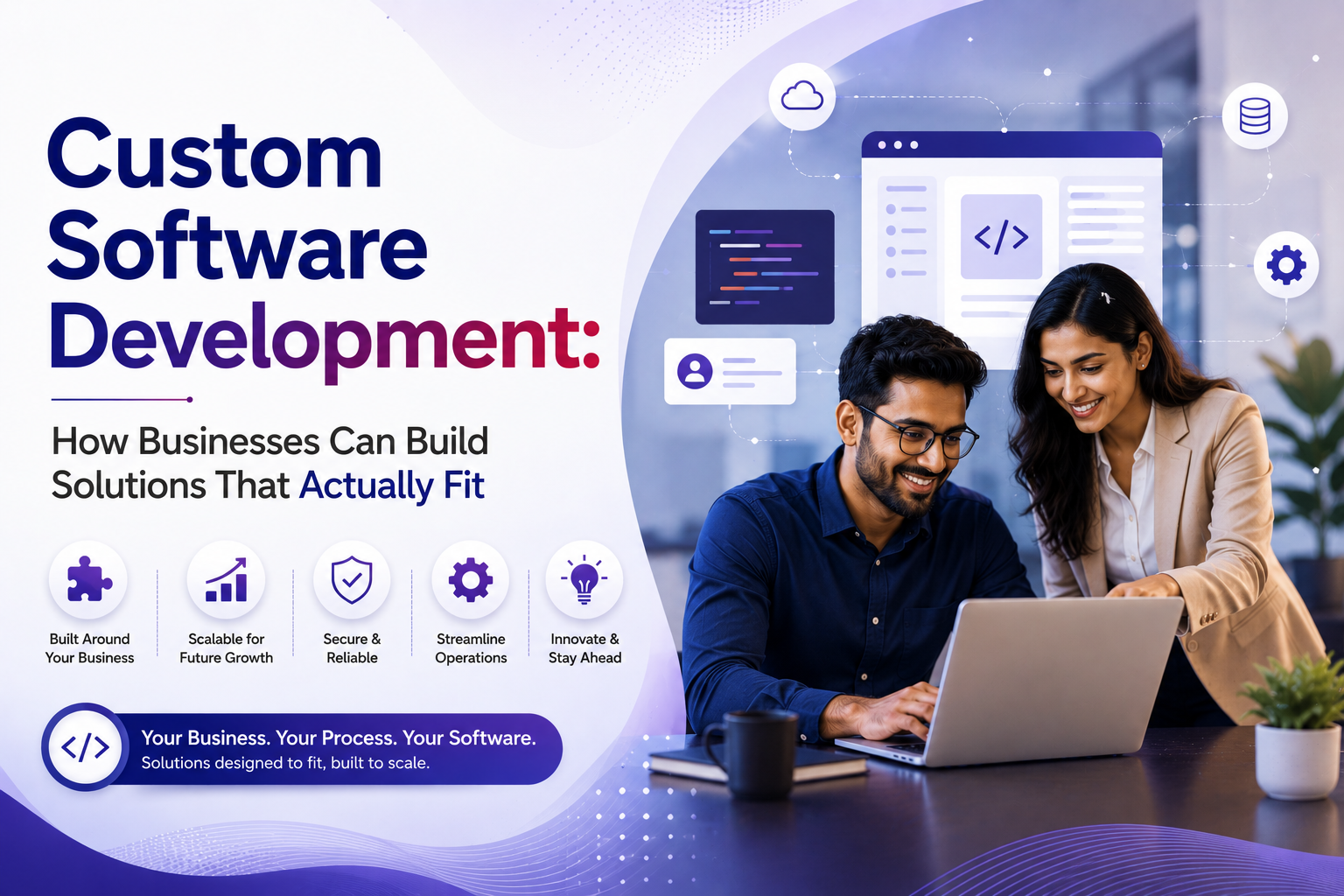
Custom Software Development: How Businesses Can Build Solutions That Actually Fit
Every business has unique workflows, customer requirements, and operational challenges. Off-the-shelf software can solve common problems, but it may not always fit specialized business processes.
That is where custom software development becomes valuable.
Custom development allows organizations to build software around their specific requirements rather than forcing their processes into a predefined platform.
1. What Is Custom Software Development?
Custom software development involves designing, building, testing, deploying, and maintaining applications specifically for an organization's requirements.
Solutions can include:
-
Web applications
-
Mobile applications
-
Enterprise software
-
APIs and backend systems
-
Customer portals
-
Internal business applications
-
Workflow automation platforms
2. When Should Businesses Consider Custom Software?
Custom development can be useful when:
-
Existing software cannot support specific workflows.
-
Multiple systems need to be connected.
-
Business processes require specialized automation.
-
The organization needs complete control over functionality.
-
Scalability is a major requirement.
-
A company is building a unique digital product.
3. Key Benefits
Business-Specific Functionality
Software can be designed around actual business processes.
Scalability
Applications can be architected to support future growth.
Integration
Custom APIs and backend services can connect the solution to existing platforms.
Better User Experience
Interfaces can be designed specifically around user workflows.
Greater Control
Businesses have greater control over functionality, integrations, and future enhancements.
4. Development Should Go Beyond Coding
Successful software projects require more than writing code.
A strong development lifecycle includes:
-
Requirement discovery
-
Solution architecture
-
UI/UX design
-
Development
-
API and integration development
-
Quality engineering and testing
-
CI/CD and deployment
-
Monitoring and maintenance
5. Building for the Future
Modern applications should be designed with scalability, security, performance, and maintainability in mind.
Cloud-native architectures, APIs, microservices, automated testing, and DevOps practices can help create applications that are easier to evolve.
Conclusion
Custom software development gives businesses the flexibility to build technology around their unique needs.
The goal is not simply to create an application. It is to build a reliable digital solution that solves real business problems today while remaining adaptable for tomorrow.